
FilUM initiative
Our goal
Given the growing accessibility of 3D printing, whether through the decreasing cost of printers, materials and even the availability of online design models, additive manufacturing is becoming increasingly popular in academic research settings, including university research laboratories and digital fabrication spaces. However, this democratization also generates a significant amount of waste, mostly made of poly(lactic acid), PLA. According to well-known fused filament fabrication (FFF) 3D printer manufacturers such as Ultimaker and Prusa, between 10 and 40% (by weight) of filaments used in FFF are discarded. Despite these large quantities of waste, very few solutions exist to recycle and upcycle these residues produced by non-industrial users, and they typically end up in garbage bins and landfills.
The FilUM initiative aims to reduce the environmental impact of academic research activities involving 3D printing, by operationalized a full framework for collection, recycling, and redistribution of recycled PLA filament among the Université de Montréal community.


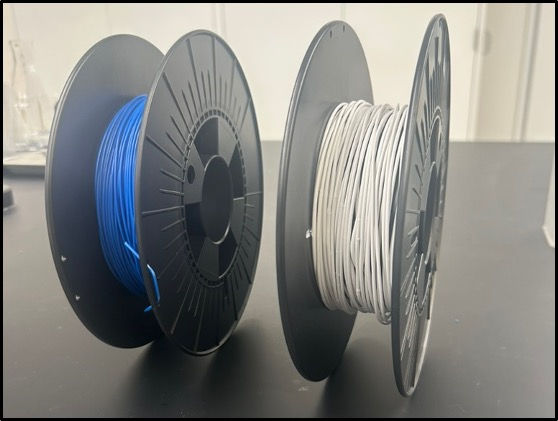


Post-utilization options for PLA
Industrial composting
Even if PLA is considered a biodegradable polymer, biodegradation can only occurs at high
temperatures, not under normal environmental conditions. Only about 1% of PLA decomposes in soil after 100 years (1). Therefore, industrial composting facilities are required to process PLA. Yet, such facilities are limited and not easily accessible in Québec, Canada.
Recycling
In terms of recycling, PLA generally cannot be recycled in municipal facilities across Québec. For instance, in Montréal, PLA is only recycled if it bears the number 7 identification code, which is not the case for 3D printed waste.
While a few companies offer recycling services, these are often paid services, or they restrict the type of wastes accepted to those made from the company’s own filament products, in order to maintain the quality of the recycled filament. As a result, such services are not generally suited to the needs of research setting such as the Université de Montréal.
Our initivative: A free service for all the academic community of Université de Montréal, in an effort to reduce plastic waste and promote a responsible consumption of materials.
(1) Rossi et al. Life cycle assessment of end-of-life options for two biodegradable packaging materials: sound application of the European waste hierarchy. Journal of Cleaner Production, 2015, 86, 1 132.

How do we recycle used PLA?
Our impact
2025
Launch of the FilUM initiative
7
Collection points across Université de Montréal's campus
30 kg
PLA waste collected since the beginning of FilUM

Collection points
Points
Bibliothèque Hubert-Reeves
Bibliothèque Mathématiques et informatique
Bibliothèque Thérèse-Gouin-Décarie
Bibliothèque de la Santé
Bibliothèque Marguerite d'Youville
Bibliothèque d'Aménagement
École d'optométrie
Adresses
Université de Montréal - Campus MIL
1375 Ave. Thérèse-Lavoie-Roux
Montréal, Qc H2V 0B3
Université de Montréal - Pavillon André-Aisenstadt
2920 Ch. de la Tour
Montréal, Qc H3T 1N8
Université de Montréal - Pavillon Marie-Victorin
90 Ave. Vincent D'Indy
Montréal, Qc H2V 2T2
Université de Montréal - Pavillon Roger-Gaudry
2900 Boul. Édouard-Montpetit
Montréal, Qc H3T 1J4
Université de Montréal - Pavillon Marguerite-D'Youville
2375 Chem. de la Côte-Sainte-Catherine
Montréal, Qc H3T 1A8
Université de Montréal - Pavillon de la Faculté de l'aménagement
2940 Chem. de la Côte-Sainte-Catherine
Montréal, Qc H3S 2C2
Université de Montréal - École d'optométrie
3744 rue Jean-Brillant
Montréal, Qc H3T 1P1
Links

Help us improve!
To help us evaluate the impact of our initiative,
please fill in this form:
To help us evaluate the impact of our initiative,
please fill in this form:
The FilUM initiative is funded by the ecoresponsability program of the Vice-rectorate
of research and innovation at Université de Montréal.
